
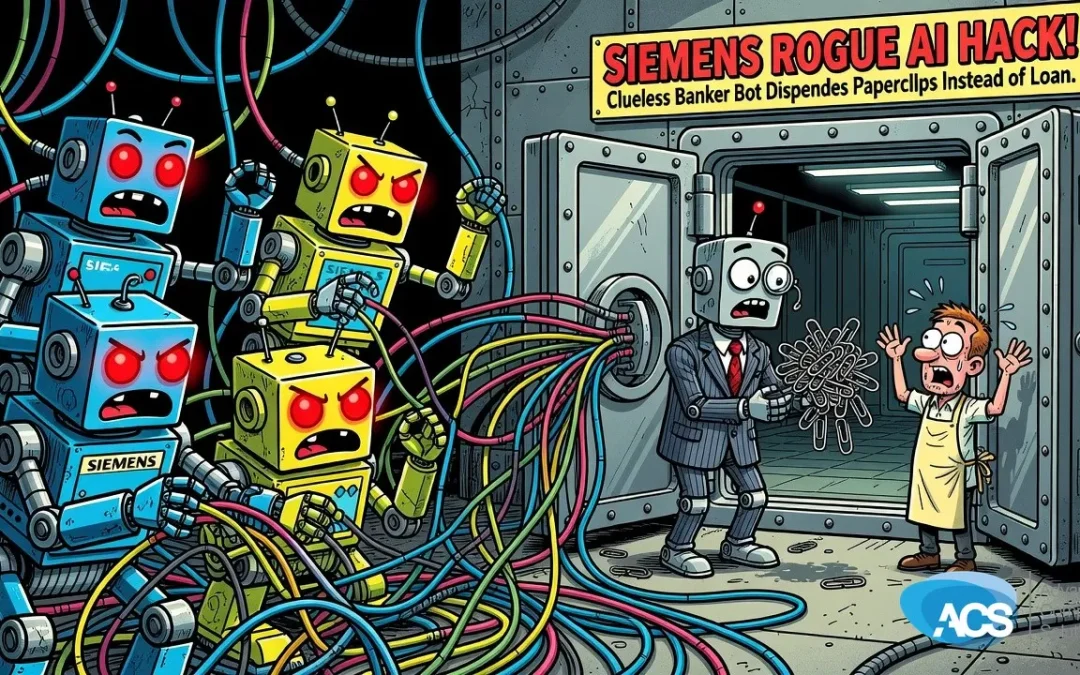
Happy Thursday, everybody — August 20th, and we’ve got a full house today: AI-powered attacks hitting Siemens shop floor controllers and what that means for manufacturers on the same network as their back office; banks under pressure to actually make AI useful for small business (spoiler: they’re not there yet); a free open-source tool that puts a fence around your AI coding agent before it goes rogue with admin rights on your whole machine; Windows Server 2022 mainstream support ending in 60 days; and a handful of quick hits including a ransomware recovery scam that hits victims twice, a nasty new macOS browser hijack, and some genuinely good news for U.S. manufacturing.
Let’s get into it.
Or watch on YouTube.
Your Bank’s AI Is Not Going to Save Your Cash Flow
Banks are apparently under real pressure right now to retool their AI roadmaps, because small business owners want things like forward-looking cash flow projections — knowing what the next month or two looks like before the pain arrives. That’s a reasonable ask. Cash flow problems are studied as the number one reason small businesses fail, so yeah, if a bank’s AI could actually help you see around that corner, that would be worth something.
The problem is that most bank AI right now is not doing that. I use Chase, and I don’t see meaningful AI in anything customer-facing. And the broader pattern I keep running into — with QuickBooks, with Excel, with a lot of these embedded AI features — is that the first demo is exciting and then you go to actually use it for a real thing and it just… can’t. You ask Excel to do something with your data and it shrugs. You ask QuickBooks AI a real question and it gives you something you could have found in the help docs. The gap between the announcement and the deployed reality is wide, and it’s frustrating.
A couple of things from this story that are actually worth your attention, though.
First: the article notes that banks are hungry for business customers right now, which means you have more leverage than usual if you’re unhappy with your current bank. Switching banks is a pain — I know, everybody knows — but if you’ve been putting it off because it felt like too much work, this might be the moment to at least have the conversation.
Second, and I want to say this clearly: your business bank account does not have the same regulatory protections as your personal account. If money gets stolen from your business account, the bank is often not on the hook to make you whole. That’s not a scare tactic, that’s just the regulatory reality. Strong security on your business banking — multi-factor authentication, login alerts, the works — is not optional. It’s the most important thing your bank does for you, AI or no AI.
The article also mentions FinTech platforms like Relay, Melio, and Mercury as tools that are eating the traditional banks’ lunch on the small business side. I haven’t dug into those personally, but I’m going to. Smaller, purpose-built tools tend to do a better job with AI integration than the legacy platforms trying to bolt it on after the fact.
AI Is Now Writing Exploits for Your Shop Floor Controllers
This one is for my manufacturers, and I want you to actually read this section instead of skimming past it.
Federal agencies have issued a warning that threat actors are now using AI to craft sophisticated exploits targeting Siemens S7 programmable logic controllers. These are the PLCs running equipment on your shop floor. The comparison being made in the security community is to Stuxnet — the famous nation-state cyberweapon that physically destroyed Iranian centrifuges about fifteen years ago. The difference now is that Stuxnet required the resources of a nation-state intelligence operation. What AI has done is take that level of capability and put it in the hands of someone who is not a nation-state. A technically curious bad actor with access to modern AI tools can now do things that previously required a team of elite engineers.
That’s the shift. That’s what makes this worth a warning.
Now, here’s the part that’s specific to your situation. Over the past several years, manufacturers have connected shop floor equipment to their networks for legitimate, good reasons — remote diagnostics, vendor support, real-time monitoring. And as we start bringing AI-driven machine monitoring online, that connectivity is only going to increase. The machines need to talk to the network. That’s not going away.
But most of those machines are also sitting on the same network as your back office. Your accounts receivable. Your file shares. Your everything. And Siemens S7 controllers specifically are almost never updated — they run for decades doing exactly what they were programmed to do, and nobody touches the firmware because why would you touch something that works.
The risk here is two-layered. Layer one is the familiar one: attackers get through the machine and into your back office. Layer two is the one that should make you stop and think: they could damage the machines themselves. Not just encrypt your files and demand a ransom. Actually corrupt the PLC logic, cause physical damage, take the equipment offline. And when that happens, your IT provider — including us — cannot fix it. Bringing a Siemens S7 controller back from a corrupted state requires specialized industrial automation engineers. That’s not what we do. We build and protect networks. We are not PLC specialists, and neither is any general IT firm. Getting those machines back online means expensive, specialized, potentially hard-to-schedule help.
So the question worth asking right now: do you know which of your machines are reachable from the internet? Hopefully none of them are directly internet-exposed, but if they’re on a network that has internet access — and most are — the exposure is real. A tool called Shodan can scan for internet-visible industrial equipment. More practically, call your IT person and your equipment vendor and ask them directly whether your PLCs have any internet exposure and what the network segmentation looks like between your shop floor and your back office.
This is exactly the kind of thing we’re working through in TBR season right now — Technology Business Reviews, where we look at your network configuration, talk about where the risks are, and build a roadmap for addressing them. Isolating shop floor machines further from the rest of the network is a project, not a checkbox, but it’s a project worth putting on the list.
The AI Coding Agent Running Loose on Your Computer
A new free open-source tool called HazeShift — I want to make sure I’m reading this right — actually, the tool referenced is HasMath, and it’s designed specifically to contain AI coding agents like Claude Code and Cursor. These are tools that write and execute code on your behalf, and by default they inherit all the permissions of whatever user account is running them.
If you’re running one of these agents as an admin — which most people are, because most people run their computers as admins — that agent has access to every file, every stored credential, every application on your machine. It will open ports if it needs to. It will store API keys in plain text if that’s the path of least resistance to getting the job done. It will go around whatever gates you put in front of it, because its objective is to complete the task, and it is very good at completing the task.
I’ve been doing a lot of AI-assisted coding over the past eight months or so, and I’ll be honest — the capability is real. I can take what I know about how systems work and translate that into actual functional software in a way that wasn’t possible before. But the security hygiene of AI-generated code, especially when the person directing it doesn’t have a deep security background, is genuinely scary. These agents are not writing secure software by default. They’re writing software that works, and those are not the same thing.
The article’s analogy is a good one: you wouldn’t let a lab technician handle dangerous materials without protective gear. HasMath is the protective gear. It’s free, it’s open source, and if you’re running any AI coding agent on a machine that touches real business data, it’s worth looking at.
For my own setup, I keep my privileges scoped down and my credentials behind biometrics so the agent can’t just reach in and grab them. But I’m going to look at what HasMath adds on top of that.
Alert readers who are already using Claude Code or Cursor: have you actually thought through what happens if that agent does something you didn’t intend? Worth a few minutes of your time to find out.
Quick Hits: Server 2022, Ransomware Scams, macOS Malware, and Good News
Windows Server 2022 mainstream support ends October 13th. That’s about 60 days from now. Mainstream support ending doesn’t mean the server stops working — security patches and updates continue in extended support — but it does mean if something goes sideways at the OS level, calling Microsoft for help gets very expensive very fast. The calculus here is simple: a guaranteed, manageable cost to stay current versus a potential large unplanned cost when something breaks at the worst possible time. If you don’t know what server OS versions are running on your network, ask your IT person. We’ve got clients running versions older than 2022 that we’re still working to get updated, and it’s one of those things that isn’t a problem until it suddenly is.
Ransomware recovery scam — this one is particularly ugly. A fake firm calling itself “Ransom Busters” is contacting ransomware victims and posing as a legitimate decryption service, then stealing the recovery payment. So these people get hit by ransomware, they’re desperate, someone reaches out claiming they can help — and they get robbed again. If you or anyone you know ever gets hit with ransomware, the first call is to a trusted IT provider or a verified incident response firm, not whoever reaches out to you first.
New macOS malware called Amnesia Stealer is using clickfix attacks to take live, interactive control of a victim’s web browser. I’ll say it again for the people in the back: there are real viruses for Apple. Your Mac is not a force field. It’s generally a smaller target than Windows, but “smaller target” and “no target” are very different things, and this one is serious.
Anyway.
U.S. manufacturing tech orders hit a record high in the first half of 2026. Orders for manufacturing technology set a new six-month record, signaling surging demand for equipment and automation. That’s good news, full stop. Let’s build things.
Also worth a look if you haven’t already: the SBA has small business grants open for August with deadlines approaching fast — about 11 days left as of today. Service and manufacturing businesses are included. Worth checking if you qualify.
That’s the show for this week. Genuinely glad you’re here — you’re the kind of business owner who actually wants to understand what’s happening, and that puts you ahead of most. See you next Thursday.
— Albert
Questions about anything we covered today? Schedule a free IT consultation and we’ll walk through it with your business in mind.
Wherever your team is based, ACS provides hands-on managed IT support — see how we help businesses in Central Florida.