
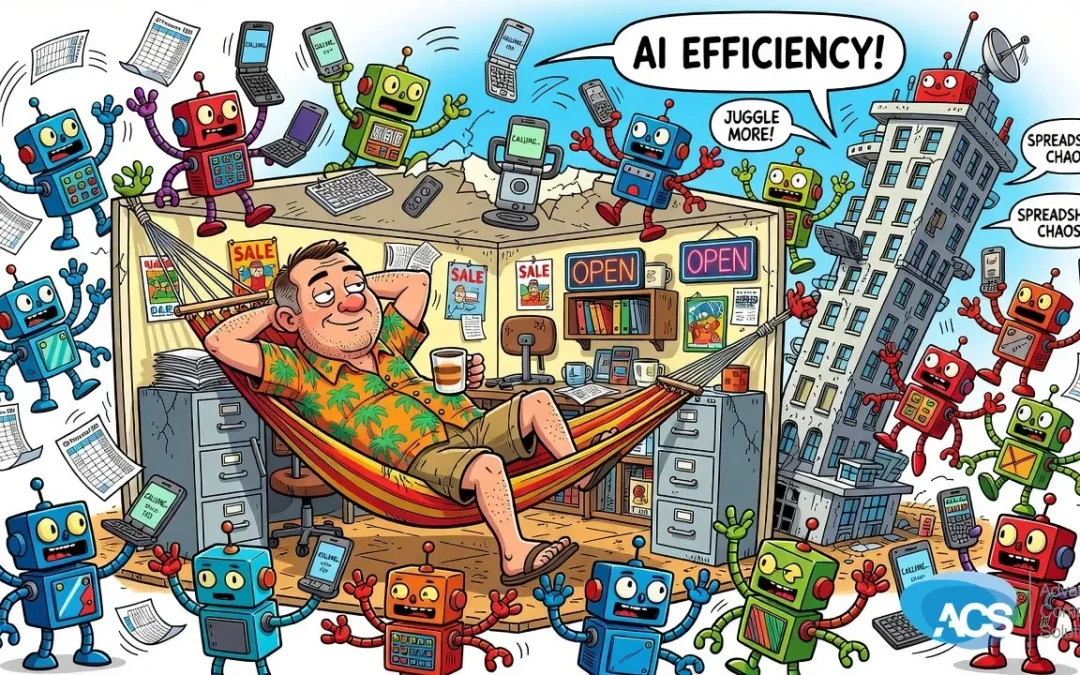
Happy Tuesday, small business owners — glad you’re here for another Nerds News; today we’re covering how AI tools are letting small businesses do more without adding people, a $50 billion Army contract that’s exclusively open to small business teams, some real-world AI wins that made it to Capitol Hill, and what I’m actually running here at ACS to put all of this into practice.
Let’s get into it.
Or watch on YouTube.
Scaling Without Hiring — What That Actually Looks Like
The Small Business and Entrepreneurship Council put out a piece this week on using AI to grow without adding staff — scheduling, invoicing, customer follow-ups, workflow management. I want to talk about this one from the inside, because we’re doing it here, not just reading about it.
The shift I’m seeing isn’t that AI replaces people. It’s that AI eliminates the work that never should have been someone’s job in the first place. You know the stuff I mean — clicking the OK button on a ticket that has the same resolution every single time. Pulling a report that follows the exact same steps every month. Making a decision that carries zero real liability but still required a human to sit there and make it. That’s not skilled work. That’s a workflow waiting to be automated.
What we’ve done at ACS is wire everything together — all the tools, all the reporting — so that I can ask one AI to run a business review, and it goes and gets the information, assembles it, and hands it back to me. That used to eat a serious chunk of hours. Now it doesn’t. Multiply that across a year and you’re talking about a meaningful amount of time returned to the business.
The other thing worth saying out loud: my staff isn’t doing less meaningful work. They’re doing more of it. The agentic automations handle the repetitive clicks. The people handle the judgment calls. That’s the right division of labor, and it took AI to finally get there.
If you want a starting point, ask your team one question: what manual process slows you down most? Then look at whatever tool you’re already paying for and find out if it already has an automation or AI feature you haven’t turned on yet. A lot of them do. I was using QuickBooks the other day to clean something up, and the AI inside it paid for itself in about two minutes of actual work. That’s not a sales pitch for QuickBooks — it’s just what happened.
The Llama Box and What Open-Source AI Actually Costs
I built what I’m calling the Llama box here in the office — our own private, internal AI running on local hardware, completely behind our firewall. Open-source models, no data leaving the building, no subscription to a cloud service that may or may not be reading your inputs. The hardware is a machine with an RTX 3090, 24 gigs of VRAM, which is enough to run some decently capable large language models.
Alert readers will notice I said “I spent more on hardware than I’ll ever recover in subscription savings.” That’s true. I’m not going to pretend this is a cost play — it’s a control play. Everything that goes into that box stays in that box. For an IT company handling client data, that matters a lot.
What I didn’t expect is how much it would change my appetite for open-source software across the board. When you have a solid AI in the background that can manage and maintain an open-source tool, the calculus changes. I’m now in the process of replacing our billing software, our CRM, our endpoint detection — moving toward open-source alternatives that the AI can keep running. The only commercial category I’m holding onto for now is the user-monitoring tools, the impossible-login detection, that kind of thing. Everything else is on the table.
I’m also running Rocketbot for the team. I looked at Claude’s Teams tier and the math didn’t work — when you move to Teams, you lose the higher usage tier, and that runs out fast when you’re putting in real hours with it. So I kept my own Claude account at the higher level and pushed the team into Rocketbot instead. It connects to Word, Excel, OneDrive, email — mostly Microsoft ecosystem stuff — and the team is now building their own tools inside it. We’re about to launch the first internally built tool that I didn’t build. That’s a milestone worth noting.
$50 Billion Army Contract — Small Business Teams Only
Washington Technology flagged this one: the Army has opened a $50 billion contract opportunity that’s exclusively set aside for small business teams, companies with 100 employees or fewer.
Small business set-asides aren’t new — they’ve been part of federal contracting for a long time. But $50 billion is a number worth paying attention to, and the teaming angle here is interesting. This isn’t structured as one company winning a giant contract. It’s designed for small businesses to collaborate and package up work together. If you’re a small manufacturer in Michigan or Florida and you’ve always assumed federal contracting was someone else’s game, this is worth a serious look.
My family has a long history working with the Department of Defense — quality work, tight specs, small businesses doing real things for Uncle Sam. I have a lot of respect for that work, and I want my manufacturing clients to know this door is open.
The place to start is your local PTAC — Procurement Technical Assistance Center — or your Small Business Development Center (SBDC). Both provide free help navigating federal contracting. A quick web search for your state’s PTAC will turn up the right office near you. And if you’ve got other small manufacturers in your network, now’s the time to have a conversation about teaming. This one is worth the phone call.
Real AI Wins — And What’s Still Just Scratching the Surface
The US Chamber of Commerce brought small business owners to Capitol Hill this week to share AI success stories. I read through the coverage, and the examples are real — they’re just modest. The one that stuck with me: a team member says “I’d love to have this report,” and two minutes later another team member comes back with it, pulled together using AI on existing documents. The room is apparently stunned.
That’s a genuine win. I’m not dismissing it. But I want to be honest with you — that’s the shallow end of the pool.
The deeper end looks like this: you’ve got a seven-year-old paper shipping document sitting in a filing cabinet. You scan it, hand it to an AI, and get back a fully editable Excel file in about a minute. That same task done manually takes an hour. Or: you’ve got a giant Excel spreadsheet that your whole operation runs on, and it’s buckling because spreadsheets aren’t databases. You hand that spreadsheet to an AI, tell it to build a proper database with a user interface, and now multiple people can edit it simultaneously, you’ve got real reporting, data integrity checks, and room to grow. That’s not a future scenario. That’s something you could do this week.
The Chamber piece is fine for what it is — a signal that small businesses are already in this, not waiting. But if a senator asked me for my AI success story, I’d skip the polished testimony and just show them the before and after on a real workflow. That tends to land better than a fact sheet.
Anyway. The tools are real, the savings are real, and the businesses figuring this out now are going to be running leaner and faster than the ones who wait. That’s not alarm — it’s just arithmetic.
Thanks for spending part of your morning with me. Go build something. — Albert
Questions about anything we covered today? Schedule a free IT consultation and we’ll walk through it with your business in mind.
Wherever your team is based, ACS provides hands-on managed IT support — see how we help businesses in Traverse City & Northern Michigan.