
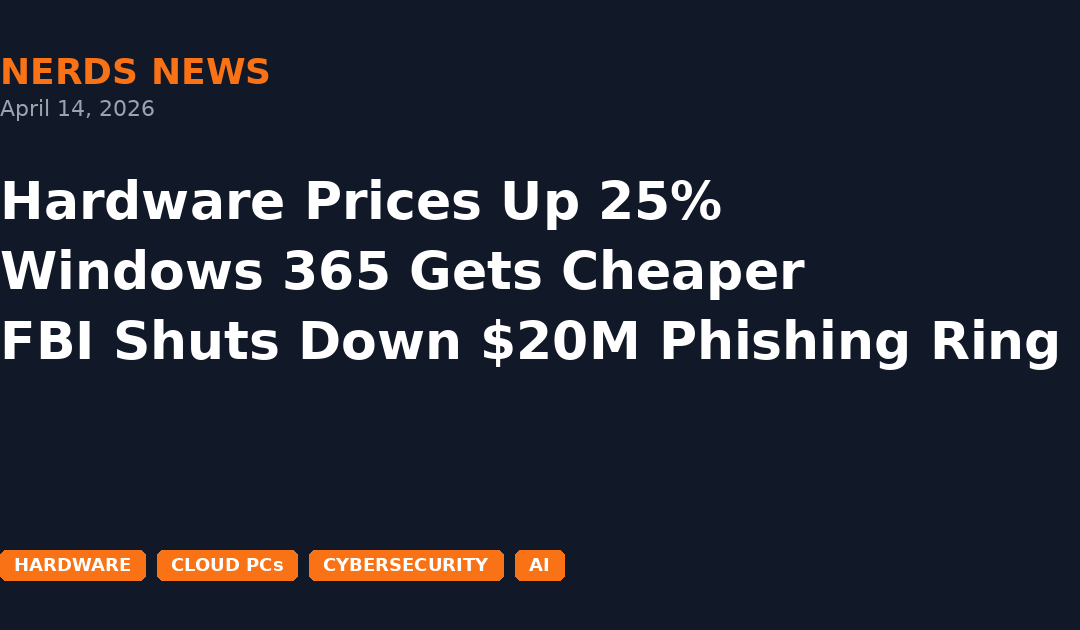
If you’ve shopped for a new PC or server lately, you’ve probably felt the sticker shock — and it’s only getting worse. Dell prices are up 17%, memory prices have doubled, and the chip shortage isn’t easing until 2028. Today’s Nerds News walks through what’s driving the hardware squeeze, why Microsoft’s Windows 365 price cut is surprisingly good news, how the FBI just took down a massive phishing operation that fooled 17,000 people, and what Anthropic’s new Claude for Word actually does.
IT Hardware Prices Are Climbing 15–25% — And It’s Going to Get Worse
Dell PCs are up 17%. Lenovo and HP aren’t far behind. The big culprit? Memory. DDR5 RAM contract prices are projected to climb 55–60% quarter-over-quarter in Q1 2026, and chip lead times have jumped 43%. AI data centers are consuming every chip they can buy, squeezing supply for everyone else.
For a small business trying to refresh aging workstations or replace a failing server, this matters. A standard business PC that was $1,200 last year may now be $1,450. Multiply that across 30 users and the budget hit is real. Industry analysts expect the squeeze to last through 2028, so the “let’s wait six months for prices to drop” strategy isn’t going to work this cycle.
The right move is to plan your hardware refresh now — prioritize machines that are on Windows 10 (end-of-life October 2025 has passed) or out of warranty, and get them quoted before the next price bump. If you want a straight answer on what to replace, when, and what the real cost will be, schedule a free IT consultation — we’ll give you a refresh roadmap that fits your budget.
Microsoft Cuts Windows 365 Cloud PC Prices 20% — Good News for SMBs
Ironic timing: as physical hardware gets more expensive, Microsoft announced a permanent 20% price cut on Windows 365 Business cloud PCs starting May 1, 2026. The cut applies to new subscriptions and renewals. Microsoft also added a hibernation feature that puts a Cloud PC to sleep after an hour of inactivity, trimming resource costs further.
For small businesses with remote or hybrid workers, seasonal staff, or users who just need a Windows desktop for a few specific tasks, Cloud PC is finally priced competitively against buying a physical laptop. You still get a full Windows experience, it’s managed centrally, and there’s no capital outlay for hardware that might sit idle.
Albert’s take: physical hardware still wins for power users and anyone who needs consistent performance offline. But for the right role — contractors, kiosks, light-use users — Windows 365 just got a lot more attractive.
FBI Dismantles W3LL Phishing Ring — 17,000 Victims, $20M Stolen, MFA Bypassed
The FBI took down an Indonesian hacker group running a phishing-as-a-service operation called W3LL. Criminals could buy a $500 phishing kit that created convincing fake Microsoft 365 login pages capable of stealing both passwords and MFA codes in real time. The operation racked up 17,000 victims and $20 million in theft before the takedown.
Here’s the painful part: multi-factor authentication is no longer bulletproof. Attackers use session hijacking and real-time “adversary in the middle” tactics to intercept the MFA token as you type it in. If you click a phishing link, enter your credentials, and approve the MFA prompt — the attacker now has full access to your Microsoft 365 account.
Do not turn off MFA. It’s still dramatically better than a password alone. But MFA is not a “set it and forget it” defense anymore. Small businesses need layered protection: conditional access policies, phishing-resistant MFA (FIDO2 / security keys for privileged users), SaaS monitoring to catch anomalous logins, and a tested backup and recovery plan for when an account does get compromised. If you haven’t reviewed your M365 security posture in the last year, schedule a consultation — the attackers are getting better faster than most businesses are.
Claude for Word Launches — AI Now Inside the Full Office Suite
Anthropic rolled out Claude for Word as a public beta add-in on April 10, completing full integration across Word, Excel, and PowerPoint. The add-in handles document review, redlining, drafting, and editing — with changes tracked natively in Word’s revision history. It’s available on Claude Team and Enterprise plans.
For small businesses already paying for Copilot, this is a real alternative worth evaluating. Anthropic’s Claude is genuinely strong at document work, and having AI assistance directly inside Word — rather than bouncing between tabs — removes friction. The honest downside: AI inside Office still doesn’t solve the “rearrange this whole document so it makes sense” problem the way most people wish it did. It’s useful for drafting, redlining, and quick edits, less so for wholesale restructuring.
Quick Hits
- Tax season scam surge. The April 15 filing deadline is driving a spike in fake IRS notices, refund status emails, and spoofed tax prep service messages. The IRS does not contact you by email. If you get one, it’s a scam.
- Apple Pay phishing texts. A new campaign is sending fake Apple Pay fraud alerts to iPhone users. Don’t click. Go directly to the Apple website or open the Wallet app to check for any real issues.
- SharePoint 2013 workflows officially dead. Microsoft retired SharePoint 2013 workflows and Add-Ins as of April 2. If your workflows stopped working, that’s why. Power Automate is the replacement — and it’s a migration project worth starting now.
Key Takeaways
- Hardware prices are up 15–25% and rising through 2028 — plan refreshes now, not later
- Windows 365 Cloud PCs just got 20% cheaper starting May 1 — worth a second look for the right use cases
- MFA alone is no longer enough; layered security is required
- Claude for Word joins the AI-in-Office race — good for drafting and redlines
- Watch for tax and Apple Pay phishing, and plan your SharePoint 2013 workflow migration
Stop Waiting on Your IT Partner
Every business running on outdated hardware, unpatched security, or MFA-alone defenses is one bad day away from a costly incident. You shouldn’t have to chase your IT company to stay ahead of this. At ACS, we build a custom IT Plan, execute it, and give you confidence that your technology is handled — so you can get back to running your business.