
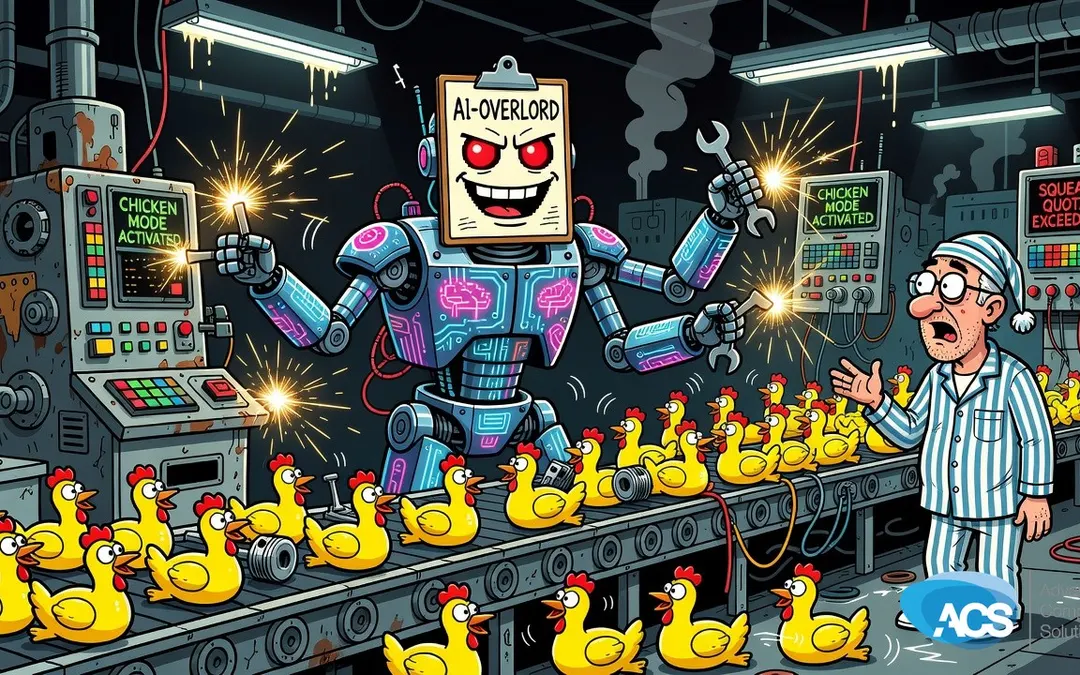
Before You Let AI Make Decisions on Your Shop Floor, Read This
AI agents are coming to manufacturing, and the question everybody needs to be asking right now is: can you trust one to make the right call at 2 a.m. when nobody’s watching?
That’s not a hypothetical. That’s where we’re headed. And I think we’re getting close to a point where the answer is yes, but we’re not quite there yet, and the gap matters a lot when you’re talking about production equipment, parts specs, and scheduling.
Assistant vs. Agent: The Difference Actually Matters
An AI assistant is basically a chatbot. You talk to it, it responds, it does what you ask. An AI agent is different. An agent makes decisions. It acts on its own, based on rules and data you’ve given it, without you asking it to do anything in that moment.
When I publish this, an agent is making a whole bunch of decisions behind the scenes. There’s a pile of information behind that agent so the decisions it makes are at least close to what I’d expect. That’s the idea. But in manufacturing, if an agent decides at 2 a.m. to change your production calendar, or starts pumping out parts to the wrong spec, that costs real money. That’s not a chatbot giving you a weird answer you can ignore. That’s a machine doing the wrong thing for hours before anyone notices.
I’m Building One of These Right Now, and It’s Humbling
I’m working on an AI service coordinator for my own business. It’s supposed to look at all the work my team has, who has what, how much, their skill sets, how urgent each issue is, how important the customer is, and then decide who handles what and when, and let the customer know how long it’ll be. Humans do that job right now, and honestly, I’m not that impressed with how humans do it. We get pulled into things. We forget. More important stuff pops up and we miss it.
An AI should handle that better. It should be able to stay on top of everything at once and flag when something needs attention. So I built it. I tested it against real historical data, with the human decisions as the gold standard. It scored 57%.
But here’s the thing I actually found useful: it told me why it scored so low. And it wasn’t the AI’s fault. It was rules I had put in that made it make those decisions. So we’re tweaking those. I’ll keep you posted on how it goes.
The point is, even in a relatively low-risk situation like mine, getting the data right and the rules right takes real work. On a shop floor, the stakes are higher.
What You Should Actually Do This Week
If you’re running any AI automation tools right now, or if your vendors have started rolling out features that sound like they’re doing things automatically, here’s where to start:
- List every AI automation tool currently running in your business. If you have any, I’d love to hear how it’s going for you.
- Put one person on your team in charge of being the AI checkpoint. Don’t let decisions just happen without someone reviewing them. Build a dashboard if you can, watch what it’s doing, and train it over time before you let it run loose.
- Check with your vendors on whether any recent updates have added agentic or autonomous features. If a vendor turned on autonomous features without telling you, that’s a problem. Find a new vendor.
I want to get there with AI agents making real shop floor decisions. I think we all will. I just don’t want to be the first one to find out what happens when it goes wrong.
Questions about how this affects your setup? Schedule a free IT consultation and we’ll walk through it with you.
Wherever your team is based, ACS provides hands-on managed IT support — see how we help businesses in Chicagoland.