
Happy Thursday, folks — Albert here, and today we are talking about something that I think every small business owner has felt at least once: the quiet frustration of paying for software that should be doing more; a new insurance company that jumped from AI startups to dry cleaners and what that move actually tells us about where AI is going for service businesses; a print management platform with a vulnerability worth knowing about; and a couple of quick hits on the ATF getting hacked and a handy new Android file-sharing tool.
Let’s get into it.
Or watch on YouTube.
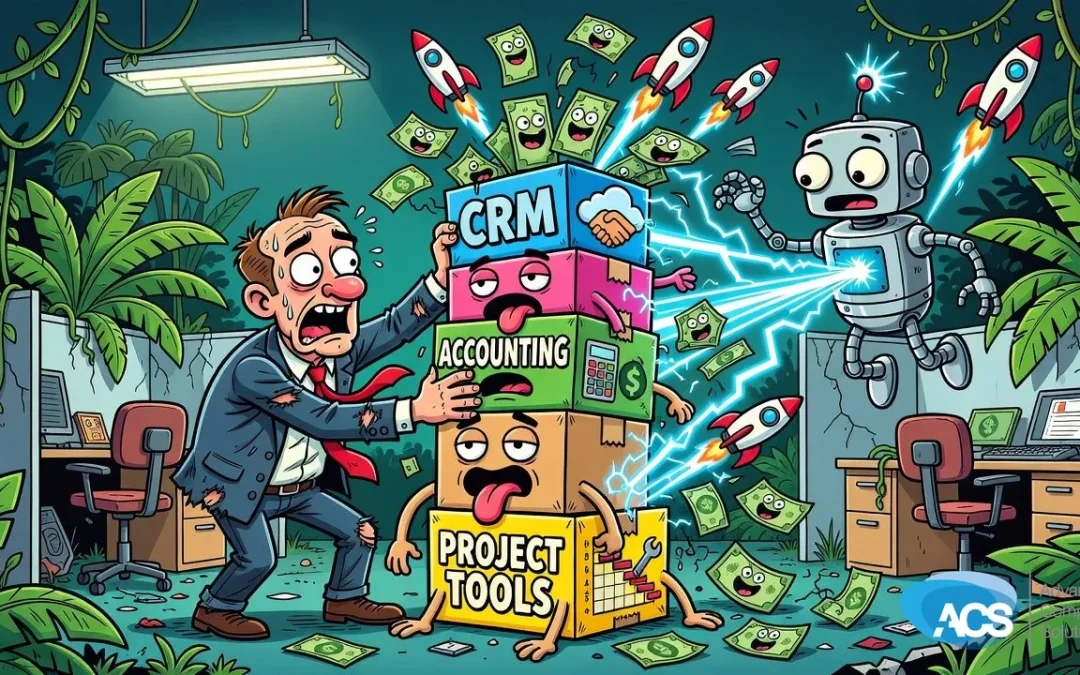
The software you already pay for is probably doing half of what it could
There is a new analysis from Dev Discourse making the rounds, and the headline is “Why your digital tools aren’t paying off and how to fix that.” The article has its own answer. I have a better one.
The finding itself is solid: small businesses are spending real money on project management software, scheduling platforms, CRMs — and not seeing measurable growth from any of it. I will be honest, I have been there too. Growing a business is genuinely hard, and no software subscription changes that on its own.
But the core diagnosis in the article is right: the problem is almost never the technology. The technology usually does exactly what it says it will do. The problem is execution. And the reason execution breaks down is that the vendor who sold you the tool almost never teaches you how to use it correctly. You buy it, you figure out the basics, and then you stop — because it is complicated and not intuitive and you have an actual business to run.
So what do you do about it? My answer: open an AI, any AI, and tell it what tool you are using and how you are currently using it. Then ask it: what else can I do with this?
That is it. That is the move.
The AI will surface every feature you are not touching, every workflow you are not running, every report you did not know existed. And then — this is the part the vendor never does — it will walk you through how to actually set it up. Step by step. Right there in the chat.
I have done this with our own professional services automation platform. I told the AI it was an ITIL expert, which is a recognized standard for delivering IT services, and then I had it walk me through restructuring everything in our system to align with those standards. The result was that I now have more real insight into our business than I have ever had. I can show customers exactly where their spend is going — what percentage is going toward maintaining their network, what is going toward security, what is going toward end-user support — in a way that is clear and meaningful. For years that kind of breakdown was hard for me to produce, if not impossible. An AI conversation with our existing tool unlocked it.
Alert readers will notice I am not recommending you buy anything new. You probably already have what you need. You just have not had the right guide yet.
What a company called Corgi tells us about AI and service businesses
There is a new insurance company called Corgi — yes, named after the dog — and the news article framed it as an insurer “built specifically for service businesses.” The AI that helped write that headline got a little carried away. Corgi started out focused on insuring AI startups. Venture-backed, angel-funded, very niche.
Now they are insuring dry cleaners and salons.
That is a significant jump, and I find it genuinely interesting — not because I think you should necessarily call Corgi for your coverage (I would still lean toward a local relationship if you can find one, though for specialty coverage like errors and omissions, those local options are increasingly hard to find). What interests me is how they made that jump.
You do not go from insuring AI startups to insuring dry cleaners without having tight information on how dry cleaners operate, what their risk profile looks like, and how to price that efficiently. My bet is they used their own clients’ tools to do it. And I would also bet they kept their costs low by putting the back-office work behind intelligent workflows and automated systems rather than hiring a wave of new insurance reps.
That is the actual story here. A company took a premium, high-touch service model, applied AI-driven automation to the operational layer, and used that to expand into markets that would not have been profitable before. The unit economics changed because the cost to serve changed.
That same logic applies to your business. If you have a premium service that requires your best people, there is probably a tier of customer below that who you currently cannot serve profitably — because you would have to use those same people at a price point that does not work. AI-driven workflows can change that math. You can start to serve a different market segment at a lower cost without pulling your best people off the work that actually pays.
Anyway. That is what the Corgi story is really about.
PaperCut has a vulnerability — check with your IT provider this week
If you are running PaperCut NG or PaperCut MF, those are print management platforms, there is a new vulnerability you need to know about. This is not the first time PaperCut has had this kind of problem — a major vulnerability in 2023 affected over 70,000 organizations globally. This new one follows the same pattern.
The article is light on specifics about what to do, so I will give you the short version: talk to your IT provider, contact your PaperCut vendor relationship, and get the patch applied as soon as possible.
Manufacturers, this one is especially for you. If you are running a shop floor or a shipping department, you are almost certainly printing — job tickets, shipping labels, work-in-process documents. Print management software sits right in the middle of that, and a compromised print server is not a theoretical problem. Get it looked at.
Quick hits: ATF breach and Android Quick Share
The ATF — Alcohol, Tobacco and Firearms — got hacked. I know that sounds alarming, but I want to be matter-of-fact about it: federal agencies with enormous budgets get breached. That is not a reason to panic; it is a reason to make sure your own house is in order. The lesson for small businesses is not “we are all doomed.” It is that security is an ongoing practice, not a one-time purchase. If the federal government cannot coast on its infrastructure, neither can you.
On a lighter note: Android Quick Share. If you are running Android devices and you want to pass files between them without cables or fussing around, Quick Share is built into Android now and worth knowing about. I am an iPhone person from the very first device out of the box, so I will not pretend to have deep opinions here — but if Android is your world, go find it on your phone or tablet and give it a try.
Until next week
That is the show. AI as your software coach, a small insurance company that quietly tells a big story about where service businesses are going, a print management patch worth checking on, and a couple of quick items to keep you current. I hope your week finishes strong — and if you make it to a Tigers game, maybe bring higher expectations than I did.
Talk soon.
— Albert
Questions about anything we covered today? Schedule a free IT consultation and we’ll walk through it with your business in mind.
Wherever your team is based, ACS provides hands-on managed IT support — see how we help businesses in Central Florida.