
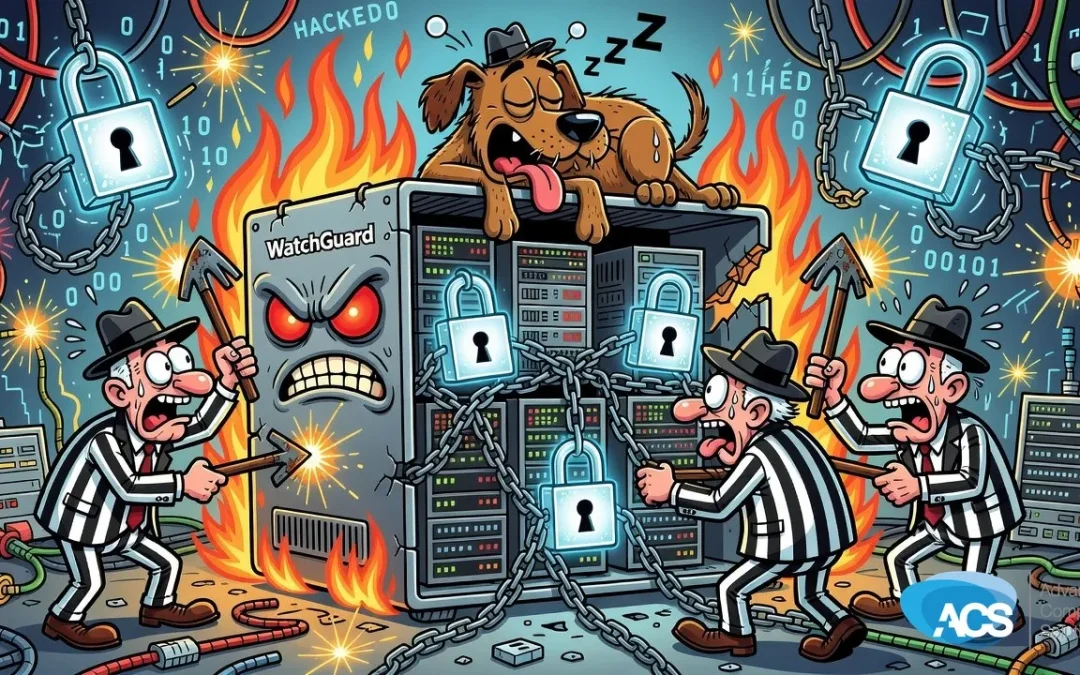
Your WatchGuard Firewall May Need a Patch Right Now
If your business runs a WatchGuard Firebox firewall, this is the one story you need to stop and read this week.
What’s Going On With WatchGuard
There’s a confirmed vulnerability in WatchGuard Firebox firewalls, and it’s not a minor one. CISA has confirmed that ransomware operators are actively targeting it right now. The flaw allows remote code execution — meaning an attacker on the other side of the world can reach into your device and run their own code on it. That’s about as bad as it gets.
On the CVSS severity scale — that’s the standard scoring system security researchers use to rate how dangerous a flaw is — this one scores a 9.8 or 10 out of 10. As Albert put it on air, “I don’t know if it gets any higher than 10.” WatchGuard is a widely used small business firewall. There are hundreds of thousands of these devices out there, which means the attack surface is enormous.
WatchGuard has been issuing vulnerability alerts, and patches are available. The problem is that a lot of businesses either don’t know about the flaw, haven’t applied the fix yet, or — and this is the part that really matters — have their management interface exposed directly to the open internet, which is exactly what the attackers are looking for.
What Ransomware Actually Does to Your Business
Here’s the part that gets glossed over when people talk about ransomware. The first wave of ransomware was bad enough — attackers would encrypt your data and hold it hostage until you paid up. But that’s not what’s happening now. Today’s ransomware gangs encrypt your data and pull it out of your network. They exfiltrate it. Then they have two ways to squeeze you: pay to get your data back, or they release it publicly.
That’s your customer records. Your financials. Your contracts. Even if you restore from backup and never pay a dime, the fact that a breach happened is blackmail material on its own. And if you’re a manufacturer, add production downtime on top of that. The average ransomware hit costs a small business between $40,000 and $50,000. That’s not a number most businesses under 100 employees can just absorb and move on from.
The villain here isn’t some abstract hacker — it’s a known, patchable vulnerability sitting in a device that’s probably been humming along in your server closet without anyone checking it in months. That’s the real risk. Not the unknown. The ignored.
The Specific Thing That Makes You a Target
The attack path here is pretty specific, and it matters. The question you need to answer is whether your WatchGuard management interface is reachable from the open internet. If it is, you’re in a much more exposed position than you should be.
This is a pattern Albert keeps seeing across these security situations — the management interface gets left open to the web, and that becomes the door attackers walk through. The right answer is to have that interface completely off the public internet. If you absolutely need remote access to it, it should be locked behind a VPN — not just sitting out there with a login page anyone can reach. And even MFA on an exposed management interface isn’t enough. It’s better than nothing, but it’s not the fix.
What To Do This Week
- Find out if you have a WatchGuard Firebox. If you’re not sure, ask whoever manages your IT. This is not the week to let that question sit unanswered.
- Check whether your management interface is exposed to the internet. Your IT person or MSP can tell you in about five minutes. If it is open, that needs to change — either close it off entirely or put it behind a VPN before anything else.
- Apply the available patches immediately. WatchGuard has issued updates. If your device isn’t current, get it patched. If you’re on a managed IT plan, confirm with your provider that this has been addressed on your specific device.
- If you’re not sure where you stand, call your MSP this week. As Albert said, “Give me a call and I’ll tell you what’s going on with it — whether you’re at risk or not — and fix it if you are.” That’s the whole job. You shouldn’t have to figure this out alone.
Questions about how this affects your setup? Schedule a free IT consultation and we’ll walk through it with you.
Wherever your team is based, ACS provides hands-on managed IT support — see how we help businesses in Chicagoland.