
Happy Tuesday, everyone — yes, Tuesday, not Thursday (I’ll be on the road Thursday, so we moved the show up); we’re covering SBIR grant reforms that could actually be worth a small manufacturer’s time, a shared skills language that might finally make your job postings stop attracting the wrong people, a Microsoft 365 outage that’s worth understanding even if it didn’t hit you, and 22,000 unpatched Exchange servers that need attention before someone else pays them a visit.
Let’s get into it.
Or watch on YouTube.
SBIR Grants: Finally Worth a Manufacturer’s Time?
I’ll be honest with you: I’m not a government grants guy. The general pattern — collect taxes, burn most of it in administrative overhead, hand the remainder back in smoldering piles — doesn’t exactly inspire confidence. But the money is there, and I want my manufacturers to get access to everything they’ve already paid for. So let’s talk about it.
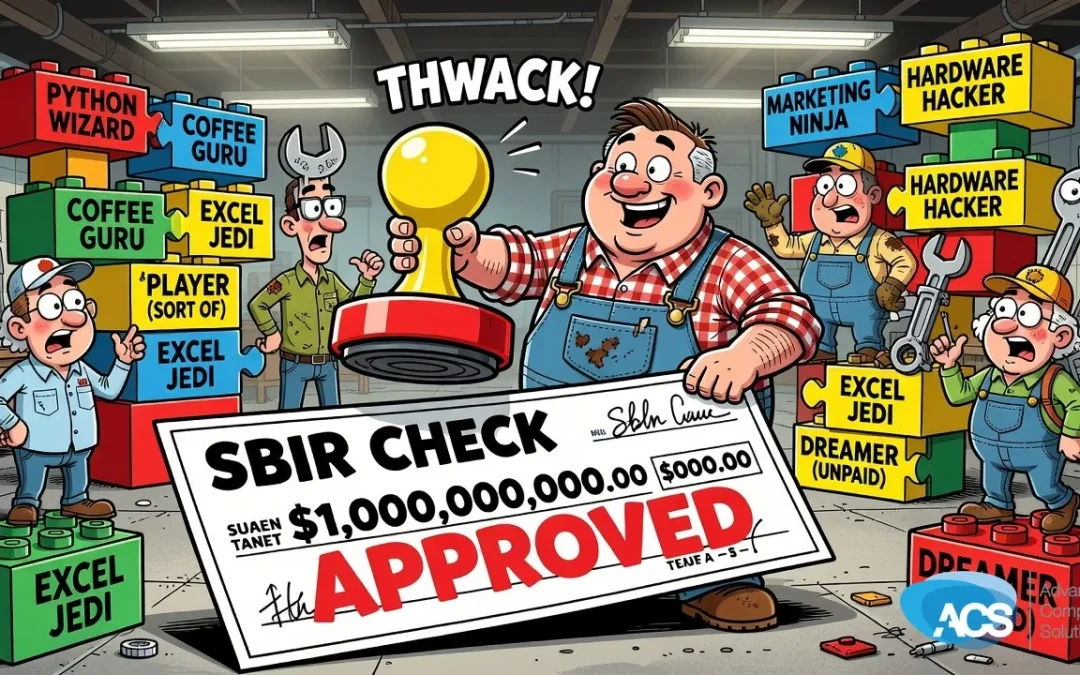
The Small Business Innovation Research program (SBIR) has been around since 1982. It funds small business innovation through federal grants — no equity to give up, no loan to repay. A Phase One award can run $150,000. That’s a real number. That’s worth your time.
The problem has always been the process. I’ve looked at SBIR before and walked away. When you’re running a shop and your day is already full of $50,000 and $100,000 problems, sitting down to chase a $4,000 grant that requires the same effort as solving a $100,000 problem is just bad math. The juice isn’t worth the squeeze — and I say that as someone who likes solving complex problems.
The proposed reforms target exactly that friction. Some applicants have been waiting 12 to 18 months from application to funding. That’s not a grant program, that’s a patience test. The new direction is supposed to compress that timeline and simplify the intake process significantly.
At $150,000 for a Phase One award, you could fund a process improvement, a new piece of equipment, or product development — with zero repayment and zero dilution. That clears my personal threshold for “worth investigating.”
The address is SBIR.gov. There’s a scoping tool there that takes about 20 minutes and tells you whether your project qualifies. I’m planning to run a few of our own projects through it after this show. If you’re a manufacturer with fewer than 100 employees and you’ve got something you’ve been wanting to develop or improve, spend the 20 minutes. Worst case, you find out it doesn’t fit. Best case, you just found $150,000 that doesn’t come with a monthly payment.
A Shared Skills Language for Manufacturing Hiring
This one came out of Advanced Manufacturing magazine, and the core problem is something I suspect a lot of shop owners have felt without having a name for it.
Two shops post a job for a “CNC Operator.” At Shop A, that means someone who can set up, program, and run the machine independently. At Shop B, it means someone who loads parts and pushes the green button. Same title, completely different skill set. The applicant pool doesn’t know which one you mean. You don’t know which one they’re trained for. And then you spend three weeks interviewing people who are wrong for the role, or worse — you hire one of them.
The effort underway is to build a nationally recognized credential framework that defines what specific skills a person actually has, so that when you post a job, you can reference a standard and the applicant can say “yes, I have that” with something behind it.
Alert readers will notice this is essentially what trade certifications do in other industries — and it works. When you hire someone with a specific cert, you know what they can do on day one. Manufacturing has been slower to standardize this, and it shows in the hiring friction.
Two practical things you can do right now:
First, pull up your current job postings and run them through an AI. Ask it: where are my skill requirements vague? It will find the gaps. This takes ten minutes and will make your next posting meaningfully better.
Second, check whether your region has a Manufacturing Extension Partnership (MEP) Center. Michigan has them. If your MEP is participating in the skills standardization effort, they can help you align your job descriptions to the emerging framework before it becomes the norm. Getting ahead of that is worth the phone call.
Hiring the wrong person is expensive in any industry. In manufacturing, where retraining someone to run a machine they’ve never touched is a real investment of time and floor space, it’s especially expensive. Anything that makes the match more accurate before the offer letter goes out is worth paying attention to.
The Microsoft 365 Outage (and the 22,000 Servers That Need Patching)
There was a significant Microsoft 365 disruption that knocked out email, Teams, and authentication for thousands of users — lasting into a second day for some. Exchange Online was the most impacted service.
It didn’t appear to affect our clients, which is good. But it’s worth doing the math for your own shop: if Microsoft went down for 24 hours and your team couldn’t get to email or Teams, what does that cost you? A 10-person service shop at $150 per employee per hour is $12,000 in a day. That’s not a theoretical number — that’s what downtime actually costs when you add up what people can’t do.
There are backup email continuity services that keep you in your inbox even when Microsoft’s infrastructure is having a bad week. They’re affordable and genuinely useful. Worth knowing they exist.
Now, the related story: 22,000 Exchange servers are still sitting out there unpatched. If you’re running on-premise Exchange — or if you migrated to Microsoft 365 but kept some on-premise Exchange functionality in the mix — this matters to you directly. An unpatched Exchange server is one of the more attractive targets out there right now. Talk to your IT person this week and confirm it’s patched. That’s the whole action item.
And if you’re still fully on-premise Exchange and haven’t made the move to Microsoft 365 yet, this is a good moment to have that conversation. The cloud version isn’t perfect (see: the outage above), but it’s a lot better than maintaining a server that’s actively being scanned for vulnerabilities.
Anyway.
Quick note from the quick hits: if your shop is collecting floor data but it’s just sitting there not connected to anything, that’s exactly what AI integration tools are starting to solve. That’s a topic for a longer episode, but file it away.
And on the ATF ransomware incident — the useful takeaway isn’t the incident itself, it’s the question it raises for your business: do you have a response plan? Not a vague “we’ll call IT” plan, but an actual sequence — who does what, who gets notified, where does work go while systems are down. If you don’t have that written down somewhere, that’s the project for this week.
I’m heading to Chicago Wednesday and Thursday — looking forward to seeing some of my favorite clients and having dinner with my other Albert down there Wednesday night. Back late Thursday. Hope everyone has a great rest of the week, and I’ll talk to you soon.
— Albert
Questions about anything we covered today? Schedule a free IT consultation and we’ll walk through it with your business in mind.
Wherever your team is based, ACS provides hands-on managed IT support — see how we help businesses in Traverse City & Northern Michigan.