
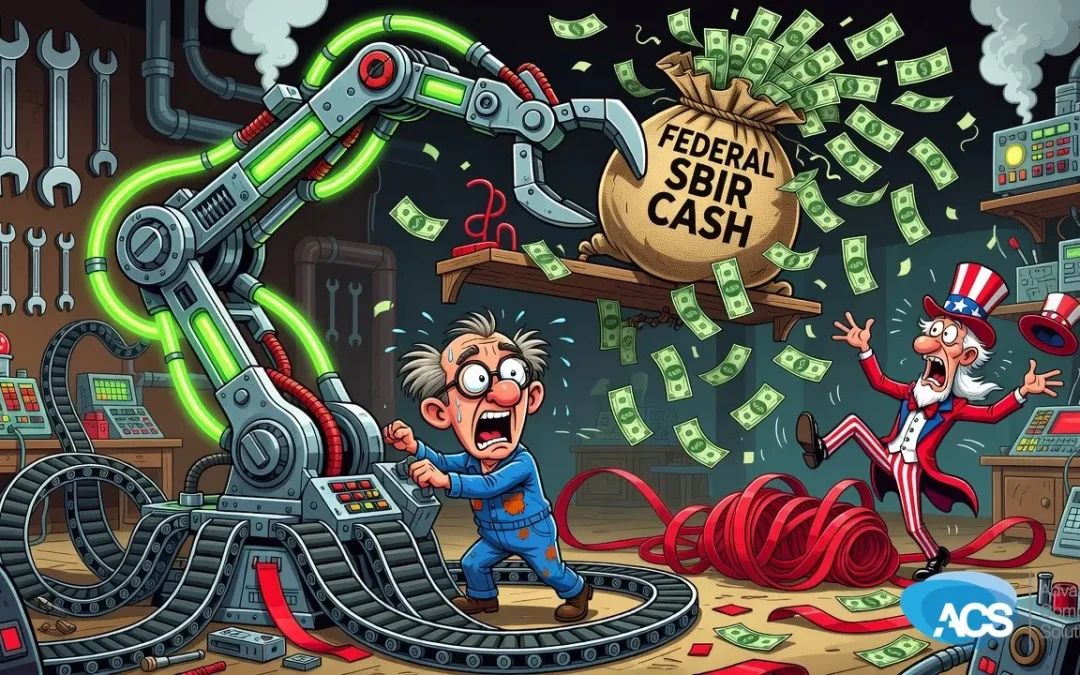
Federal R&D Money Is Getting Easier to Reach — Here Is What Small Manufacturers Should Know About SBIR
You paid into this system. You might as well know how to get something back out of it.
The Small Business Innovation Research program — SBIR — has been around since 1982. It hands out federal grants to small businesses for things like process improvements, new equipment, and product development. No equity to give up. No loan to repay. A true grant. And if you have under 100 employees, you are exactly the kind of business this program is supposed to serve.
So Why Haven’t You Applied?
Probably for the same reason most small business owners haven’t. The process is a pain. It takes forever. And the math just doesn’t work when you’re running a shop.
Think about it this way — if you spend your day chasing $50,000 problems and $100,000 problems, turning around to chase a $2,000 or $4,000 grant that takes the same amount of effort doesn’t make any sense. The time cost alone kills it. That’s been the reality for a lot of small manufacturers, and it’s a legitimate frustration.
But here’s where it gets more interesting. A Phase One SBIR award can be up to $150,000. That’s a different conversation. That’s worth investing some real time into. And that’s exactly the number that gets proposed reforms off the ground — because at $150,000, you’re not chasing pennies anymore.
What the Proposed Changes Are Targeting
The biggest complaint about SBIR has always been the wait. Some applicants sit on their hands for 12 to 18 months between application and funding. For a small manufacturer trying to move on a new piece of equipment or a process improvement, that kind of delay can kill the whole project before it starts.
The proposed reforms are aimed squarely at speed — cutting down the time between application and award so that the money actually arrives while the opportunity still exists. That’s the right target. A grant program that moves slower than your bank loan isn’t solving anything.
There’s also the complexity problem. The application process has historically been built for organizations that have someone on staff whose whole job is writing grants. Most small manufacturers don’t have that person. You’ve got a production floor to run. So the barrier to entry has always been tilted toward bigger outfits — which is exactly backwards from what the program is supposed to do.
If these reforms go through the way they’re being discussed, the idea is that a smaller shop can actually compete for this money without hiring a consultant just to fill out the paperwork.
What This Means for Your Business
The villain here is wasted opportunity. There is federal money sitting on the table that your business helped fund through taxes, and most small manufacturers never see a dime of it because the process is designed for people with more time and more staff than you have. That’s the real cost — not just the dollars you didn’t get, but the equipment you didn’t buy, the process improvement you didn’t make, the product line you didn’t develop.
If you’ve been sitting on an idea for a new product, a smarter production process, or a piece of technology that could change how your shop operates, SBIR is worth a serious look right now — especially if the reforms move forward and the timeline gets shorter. A $150,000 non-dilutive grant with no repayment is real money for a small manufacturer. It can fund the kind of project that would otherwise sit on a whiteboard for three years waiting for the right quarter.
And even if you’re not sure whether your project qualifies, there’s a fast way to find out. The SBIR website — SBIR.gov — has a tool that takes about 20 minutes and tells you whether your project is likely to qualify. That’s a Tuesday afternoon well spent.
What To Do This Week
- Go to SBIR.gov and run the qualification check. It takes about 20 minutes. Pick your scope and let the tool tell you whether your current project is a fit. You might be closer than you think.
- Write down the project you’d fund if money weren’t the obstacle. Process improvement, new equipment, product development — get it out of your head and onto paper before you look at the application. That clarity makes everything faster.
- Find your regional MEP Center. Manufacturing Extension Partnership centers are set up specifically to help small manufacturers navigate programs like SBIR. There’s one near you. They can help you figure out whether to apply and how to do it without losing weeks of your life.
- Don’t wait for the reforms to be finalized. The qualification check costs you nothing. If your project qualifies, you’ll be ahead of the manufacturers who waited to see how the changes shake out.
Questions about how this affects your setup? Schedule a free IT consultation and we’ll walk through it with you.
Wherever your team is based, ACS provides hands-on managed IT support — see how we help businesses in Traverse City & Northern Michigan.